
Ayesha Khalid Chaudhry, SIGA Fellow, Australia
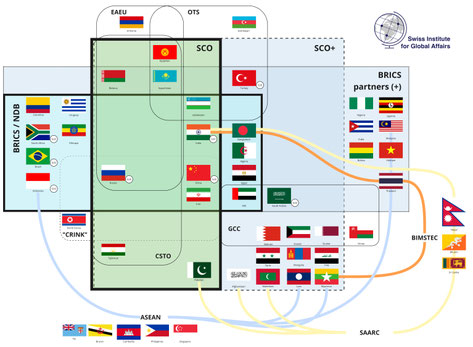
The 47th ASEAN Summit, conducted in Kuala Lumpur from 26 to 28 October 2025, in conjunction with the fifth RCEP Leaders’ Meeting, provided a distinct overview of the evolution of Asia’s regional institutions. These events signified more than mere diplomatic protocol. They demonstrated how South and South-east Asia are subtly transforming, establishing a network of economic and political collaboration that is progressively self-sufficient and less reliant on Western structures. The Swiss Institute for Global Affairs’ Venn diagrams accompanying this article illustrate the transition. It illustrates the interconnections of ASEAN, RCEP, BRICS+, SCO+, GCC, and BIMSTEC, forming a complex yet cohesive network that connects the Pacific to the Gulf.
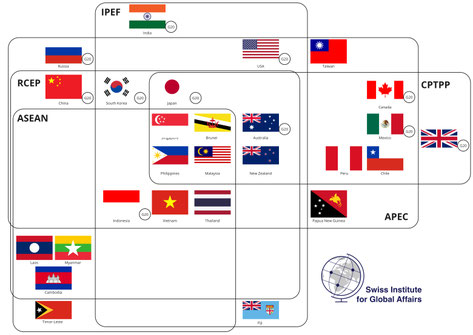
ASEAN is at the core of this structure. The Kuala Lumpur summit affirmed its position as the principal political centre of the region. A principal conclusion of the summit was the endorsement of an enhanced ASEAN–China Free Trade Area agreement, designed to augment digital trade and foster collaboration in the green economy. The admittance of Timor-Leste as ASEAN’s eleventh member also marked a significant decision, being the bloc’s first new entrance since 1999. The action broadened ASEAN’s influence throughout South-east Asia and underscored its dedication to regional inclusion. The meeting attracted leaders from China, Japan, South Korea, India, Australia, Brazil, Canada, and the United States. Their presence emphasised ASEAN’s role as a forum where major powers interact through multilateralism instead of bilateral competition. Malaysia’s chair statement emphasised connectivity, sustainability and stability, concepts that delineate ASEAN’s future framework of regional cooperation on Asian principles.
The Regional Comprehensive Economic Partnership, or RCEP, traverses the ASEAN region. Ratified in 2020 and enacted in 2022, it connects the 10 ASEAN nations (now 11) with China, Japan, South Korea, Australia, and New Zealand, establishing the largest free trade zone globally. Collectively, these fifteen economies account for around 30 percent of global GDP. At the RCEP meeting in Kuala Lumpur, ministers affirmed that Hong Kong, Sri Lanka, Chile, and Bangladesh have officially indicated their interest in accession. All member nations endorsed the review of these applications. If sanctioned, RCEP would broaden its influence into South Asia and Latin America, so enlarging the scope of Asia’s economic network. The RCEP is fortifying Asia’s economic underpinnings with pragmatic measures. It streamlines trade procedures, standardises digital and intellectual property laws, and unifies the region’s largest economies (China, Japan, and South Korea) inside a single framework. The pact currently represents about fifty percent of ASEAN’s trade, indicating that regional integration is now practical rather than merely theoretical.
In addition to trade, BRICS+ and the SCO enhance political and strategic complexity. Their expanding membership, which includes new participants from the Gulf, connects Asia’s industrial and energy powerhouse. BRICS+ advocates for financial cooperation and trade in local currencies, whereas the SCO has transitioned from a security forum to a platform for regional infrastructure and connectivity. Collectively, they enable states to regulate competition by collaboration instead of antagonism. The GCC and BIMSTEC broaden these connections to the west and south. The GCC’s collaborations with ASEAN and increasing investments from Gulf nations in South-east Asian energy and infrastructure illustrate the strengthening connection between the Gulf and Asia. BIMSTEC links South and South-east Asia via initiatives such as coastal shipping and collaborative electricity systems.
The overlapping memberships provide states with options. China, India, Thailand, and Indonesia participate in multiple frameworks, facilitating ongoing development despite potential delays in any single forum. The outcome is a complex structure propelled by regional collaboration rather than Western-oriented alignment. The impacts are evident. ASEAN’s commerce with RCEP participants currently exceeds its trade with the EU and the US, while investment from East Asia and the Gulf is increasing. Regional organisations are expanding their focus to encompass security and sustainability. Efforts in maritime cooperation, cyber stability, and energy transition demonstrate that Asia is addressing security through discussion and interdependence rather than reliance on external forces.
The accompanying Venn diagrams visually illustrate this evolution. ASEAN constitutes the political nucleus, RCEP functions as the broader economic framework, BRICS+ and SCO+ enhance strategic and financial influence, and GCC and BIMSTEC link Asia to the Gulf and South Asia. The overlaps indicate that regional collaboration functions through interconnected layers instead of strict hierarchies. South and South-east Asia are not dismissing the West, rather, they are redefining their role within the international system. They are developing a connectivity paradigm founded on partnership rather than patronage, a regional order that emerges within rather than externally.