
By Kim Yuen Martina Troxler
PhD Candidate, Monash University
10 February 2026
When a legislator from Kinmen 金門 (Quemoy), Chen Yu-jen 陳玉珍, a Kuomintang representative for the island constituency, recently stated, “I am Fujianese; I was never Taiwanese,” the remark quickly became a political controversy in Taiwan, where questions of national identity remain deeply contested (Liberty Times Net 2026; Formosa TV News Network 2026). Yet for many residents of Kinmen, the statement did not sound radical; it sounded familiar. The significance of the comment lies less in its provocation than in what it reveals about how identity in Kinmen has long been shaped by geography, history, and sustained geopolitical pressure. As Zhang and Crang (2016) argue in their study of Kinmen’s post-military landscape, the islands constitute a “fractured place” in which political affiliation, cultural belonging, and historical memory do not neatly align, producing identity positions that are internally coherent locally but often appear contradictory from the centre. At the same time, Chen Yu-jen’s statement should not be read as representative of Kinmen society. Rather than a collective claim, it functions as a useful entry point into a broader and well-documented pattern in which identity in Kinmen is layered and closely entangled with cross-strait politics and local grievances toward Taiwan’s political centre (Huan and Tan 2019).
Viewed from this perspective, the controversy offers insight into how borderland societies navigate sovereignty and identity under conditions of prolonged strategic tensions. Border studies scholarship emphasizes that in such settings, the relationship between state membership, national identity, and cultural belonging is often unsettled rather than aligned. Wilson and Donnan (2012) argue that borderlands are social spaces in which identities are shaped through everyday practices and historical experience, producing forms of belonging that are meaningful and coherent locally even when they diverge from dominant national narratives articulated at political centres. From this perspective, Chen Yu-jen’s distinction between Republic of China citizenship and a Taiwanese identity reflects a broader borderland condition in which affiliation with the state does not necessarily translate into identification with the nation as defined from the centre.
Kinmen occupies a singular position in East Asian geopolitics. Governed by the Government of the Republic of China (ROC, Taiwan Area), it lies only a few kilometres from the coast of the People’s Republic of China (PRC). For decades, it has existed not only as a military buffer but also as a lived social space shaped by war preparedness, psychological operations, and constant geopolitical signalling. To speak of identity in Kinmen is therefore never merely a cultural question; it is inseparable from security, sovereignty, and survival. Importantly, as Zhang and Crang (2016) emphasize, Kinmen’s geopolitical condition is experienced through material environments – tunnels, observation posts, ruins, and museums – that shape how residents and visitors sense, remember, and interpret cross-strait relations. The island’s strategic significance emerges from these layered histories, most notably the Chinese Civil War (1927-1949) and the Cold War, which elevated the island into a symbolically and strategically charged site of competing sovereignty claims (Gandil 2025).
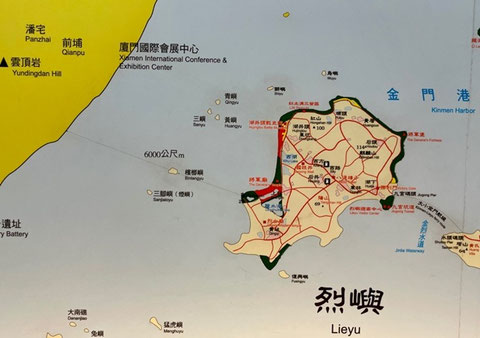

Figure 1. Composite photograph taken by the author on Lieyu (烈嶼, also known as Little Kinmen) in April 2025. Left: Map displayed at the Hujingtou Battle Museum showing Lieyu’s location approximately 5-6 km from the Xiamen coast of the PRC. Right: View toward Xiamen photographed through an observation post on Lieyu; due to foggy conditions, visibility is limited. A shoreline slogan reading “一國兩制, 統一中國” (“One Country, Two Systems, Unify China”) was present but is not clearly legible in the image.
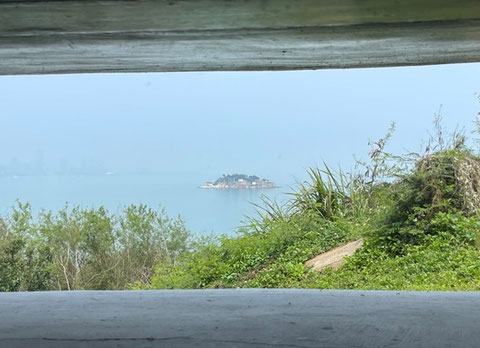
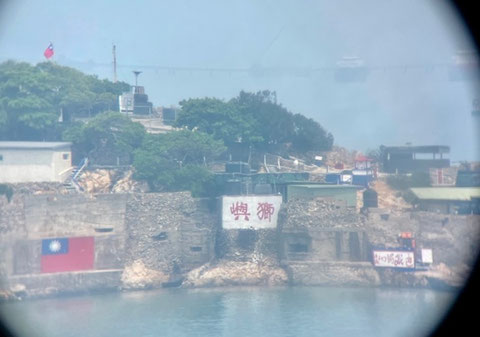
Figure 2. View of Shiyu (獅嶼) through an observation post on Lieyu, photographed in April 2025. Shiyu is a small island administered by the ROC under Kinmen County, located approximately 4 km from the Xiamen coast of the PRC. The ROC flag is visible on the islet’s shoreline, underscoring its ongoing strategic and symbolic presence in the strait.
During the Cold War (roughly 1949–1979), Kinmen was cast as the “anti-communist frontline,” absorbing artillery bombardments and hosting massive troop deployments. Its strategic salience was cemented during the 1954–55 and 1958 Taiwan Strait crises, when Kinmen became a focal point of military confrontation and signalling between the PRC, the ROC, and the United States, a role documented by Halperin (1988). Even after large-scale hostilities subsided, the island never exited geopolitics. Today it is often described as the “first line of resistance against China,” even as its residents continue to rely on economic exchange, water supply, and everyday interaction with the Chinese mainland (Yahoo News Taiwan 2026). This coexistence of deterrence and dependence shapes a distinctive political psychology. Rather than becoming strategically obsolete, Kinmen has been reconfigured from a heavily militarized garrison into a peripheral yet politically salient space within cross-strait competition, increasingly shaped by indirect pressure and grey-zone dynamics (Gandil 2025).
Many Kinmen residents express strong emotional attachment to the ROC while remaining ambivalent or even resistant toward a Taiwanese national identity defined primarily from Taipei (Huan and Tan 2019). This ambivalence is better understood as historical sediment than partisan politics. Decades of militarization, propaganda, and psychological warfare shaped how people understood “the enemy,” “the state,” and their own place within a divided political order. These distinctions are reinforced through the island’s built environment and heritage landscape, where former military spaces are curated and repurposed, keeping geopolitics present in ordinary routines and public memory (Zhang and Crang 2016). Language further anchors these boundaries. As sociolinguistic research by Wan (2022) shows, local speakers often differentiate Kinmenese Hokkien from Taiwanese Hokkien, treating speech not simply as regional variation but as an identity marker that resists incorporation into Taiwan-centred narratives.
Debates within Taiwan itself have periodically exposed the fragility of Kinmen’s position within national imaginaries. In 1994, former Democratic Progressive Party (DPP) leader Shih Ming-teh (施明德) advanced what became known as the 金馬撤軍論 (“Kinmen-Matsu Withdrawal Theory”), proposing that Taiwan withdraw all military forces from Kinmen and Matsu and transform the islands into non-militarised zones oriented toward peace and economic development (Kinmen County Government 2023). Proponents argued that these islands were strategically indefensible in modern warfare – too close to the mainland and too distant from Taiwan – and that maintaining them as frontlines imposed disproportionate costs. Critics, particularly in Kinmen, viewed the proposal as abandonment rather than pragmatism, and the idea triggered intense backlash (United Daily News 2003). Although never adopted as official DPP policy, the debate remains significant: it underscores how Kinmen’s continued inclusion within Taiwan’s defence posture is not only a military calculation but also a question of identity – of whether the ROC remains a polity extending beyond Taiwan itself or one increasingly defined by the island alone.
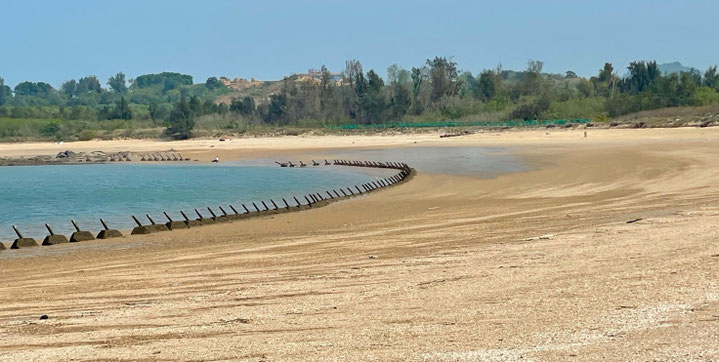
Figure 3. Beach beside the Mashan Observation Post with anti-landing obstacles embedded in the sand, photographed in April 2025.
In dominant strategic narratives, Kinmen often appears as a strategic chess piece, defined by its military significance rather than its social life. From within Kinmen itself, geopolitics is tangible and immediate – military installations beside villages, restricted coastlines, memorials to bombardments, and ongoing surveillance at sea. This framing has resurfaced in international reporting, with Kinmen and nearby islets recently described as “the frontline of the frontline” amid renewed cross-strait tensions and a cautious reopening to tourism (Reuters 2025).
Precisely because of this position, Kinmen offers a rare opportunity to examine information warfare and deterrence as lived conditions rather than abstract doctrines. Recent analyses by Gandil (2025) and Murphy (2025) suggest that this liminal status is precisely what gives the island contemporary strategic value: for Beijing, sustained grey-zone pressure and narrative framing offer leverage without the costs of outright seizure; for local actors, demilitarization and historical reframing provide limited but meaningful avenues to reclaim agency.
This blog series adopts a geopolitics from below perspective, drawing on social-anthropological observation, historical memory, and everyday practices. Rather than asking only how states deploy Kinmen within broader strategic competition, it asks how Kinmen’s people navigate, reinterpret, and sometimes resist the geopolitical roles assigned to them. This article forms the first part of a six-part blog series examining Kinmen as a critical yet underexplored site of geopolitical tension in the Taiwan Strait. It introduces Kinmen from the margins, focusing on identity, history, and geopolitics as lived experience. The series then moves from foundations to mechanisms: from Cold War militarization and survival (2), to the instruments of psychological warfare (3), to the routines of everyday life under permanent security presence (4), and finally to Kinmen today as a site of tourism, memory politics, and information contestation (5), culminating in a broader reflection on what Kinmen reveals about cross-strait relations (6). For readers outside East Asia, Kinmen illustrates how geopolitical competition is sustained below the threshold of war and how borderland communities learn to live with that condition over time.
References
Formosa TV News Network (民視新聞網). “陳玉珍自稱「福建金門人」遭網酸 民眾身份認同投票結果超意外?” [“Chen Yu-jen Calls Herself a ‘Fujian Kinmen Person,’ Draws Online Backlash; Public Identity Poll Results Are Unexpected?”]. YouTube video, approximately 10 minutes. Published 2026. https://youtu.be/DNU53hnoUOU (accessed January 28, 2026).
Gandil, Alexandre. “Beyond the Median Line: Reassessing Kinmen’s Geostrategic Significance, Past and Present.” Taiwan Security and Diplomacy Program. Foundation for Strategic Research, October 29, 2025. https://www.frstrategie.org/en/programs/taiwan-security-and-diplomacy-program/beyond-median-line-reassessing-kinmen-s-geostrategic-significance-past-and-present-2025 (accessed January 30, 2026).
Halperin, Morton H. The 1958 Taiwan Straits Crisis: A Documented History. Santa Monica, CA: RAND Corporation, 1988. https://www.rand.org/content/dam/rand/pubs/research_memoranda/2006/RM4900.pdf (accessed January 30, 2026).
Huan, Amanda, and Tan, Ming Hui. “Kinmen at the Crossroads: A Balancing Act?” RSIS Commentary no. 183. S. Rajaratnam School of International Studies, Nanyang Technological University, September 18, 2019. https://rsis.edu.sg/rsis-publication/rsis/kinmen-at-the-crossroads-a-balancing-act/ (accessed January 30, 2026).
Kinmen County Government (金門縣政府). “金門瞭望〉《金馬撤軍論》施明德30年不變的主張” [“Kinmen Outlook: Shih Ming-teh’s ‘Kinmen-Matsu Military Withdrawal Theory’ – An Unchanged Position for 30 Years”]. October 20, 2023. https://www.kinmen.gov.tw/News_Content2.aspx?Create=1&n=98E3CA7358C89100&s=9B7078A27CF60467 (accessed February 1, 2025).
Liberty Times Net (自由時報電子報). “陳玉珍自認福建人,非台灣人!梁文傑冷回‘這3字’” [“Chen Yu-jen Identifies Herself as Fujianese, Not Taiwanese; Liang Wen-chieh Responds with ‘These Three Words’”]. January 16, 2026. https://news.ltn.com.tw/amp/news/politics/breakingnews/5312553 (accessed January 30, 2026).
Murphy, Ian. “Securitizing Kinmen: China’s Gray Zone Strategy and the Evolution of the Kinmen Model.” Inter Populum, November 11, 2025. https://interpopulum.org/securitizing-kinmen-chinas-gray-zone-strategy-and-the-evolution-of-the-kinmen-model/ (accessed January 30, 2026).
Reuters. “On the ‘Frontline of Taiwan’s Frontline’ with China, a Cautious Opening to Tourists.” October 23, 2025. https://www.reuters.com/world/china/frontline-taiwans-frontline-with-china-cautious-opening-tourists-2025-10-23/ (accessed January 30, 2026).
United Daily News (聯合報). “遊金門 施明德重提撤軍論 認為應朝特區化觀光發展 才能促進金馬繁榮” [“Visiting Kinmen, Shih Ming-teh Revives the Withdrawal Proposal, Arguing That Special-Zone Tourism Is the Path to Prosperity for Kinmen and Matsu”]. March 8, 2003.
https://www.nsysu.edu.tw/p/404-1000-53671.php?Lang=zh-tw (accessed February 1, 2025).
Wan, Tsung-Lun Alan. “Islands, Geopolitics and Language Ideologies: Sociolinguistic Differentiation between Taiwanese and Kinmenese Hokkien.” Language & Communication 83 (2022): 36–48.
Wilson, Thomas M., and Donnan, Hastings. “Border and Border Studies.” In A Companion to Border Studies, edited by Thomas M. Wilson and Hastings Dinnan, 1-25. Hoboken, NJ: Blackwell Publishing Ltd., 2012.
Yahoo News Taiwan. “陳玉珍:不是台灣人惹議,想認識離那麼遠的金門,外媒都找無黨籍議員董森堡” [“Chen Yu-jen: ‘Not Taiwanese’ Remarks Spark Controversy; Foreign Media Seek to Understand Distant Kinmen through Independent Councillor Tung Sen-pao”]. March 15, 2026.
https://tw.news.yahoo.com/陳玉珍-不是台灣人-惹議-想認識離那麼遠的金門-外媒都找-234000254.html (accessed January 29, 2026).
Zhang, J. J., and Mike Crang. “Making Material Memories: The Politics of Heritage in Post–Cold War Kinmen.” Cultural Geographies 23, no. 3 (2016): 421–439.