
PhD Candidate, Monash University
25 March 2026
Kinmen’s Cold War history is often narrated through military crises, artillery exchanges, and its place in cross-strait strategy. Much of the earlier literature on the Taiwan Strait has focused on deterrence, escalation, alliance politics, and high-level decision-making, with less attention to everyday life on the islands themselves (Halperin 1988; Elleman 2021). Yet for decades, Kinmen was not only a site of crisis, but a place where war was lived, anticipated, and embedded in daily routines. Rather than revisiting these strategic dynamics, this article focuses on how such conditions were experienced on the ground. Reconsidering Kinmen from this perspective also offers a way of thinking about cross-strait tensions beyond moments of crisis, highlighting how prolonged confrontation shapes societies over time.
For those who lived on Kinmen, militarisation was not only a matter of geopolitics or defence planning. It structured everyday life, shaping movement, housing, communication, and the use of homes, temples, and public space. During this period, Kinmen functioned as what has been described as a “combat economy,” in which local livelihoods were closely tied to the presence of Nationalist troops and civilian access from Taiwan was restricted due to the island’s military sensitivity (Denton 2021). It also reshaped how time was experienced – not simply through moments of crisis, but through prolonged uncertainty, repetition, and regulation.
Prior to 1949, Kinmen was home to a predominantly Minnan-speaking population with close social, cultural, and economic ties to nearby Fujian on the mainland, a linguistic and cultural pattern that has largely continued into the present. During the Cold War, this civilian population lived alongside a large and fluctuating military presence that profoundly transformed the island’s social and spatial order (Chiu 2023). The result was not simply coexistence between soldiers and civilians but a sustained overlap between military and civilian life.
Kinmen’s Cold War position was shaped by a sequence of military confrontations in the first decade after 1949. Following the outcome of the Chinese Civil War (1945–1949) and the establishment of the People’s Republic of China (PRC) on the mainland, the Kuomintang (KMT) retreated to Taiwan together with the government of the Republic of China (ROC). At this point, however, the ROC still retained control over several offshore islands along the southeast coast, including Kinmen (Chiu 2023). In October 1949, ROC forces repelled a landing attempt by the People’s Liberation Army (PLA) at Guningtou. This was a major turning point, as it secured ROC control over Kinmen and helped prevent a further PLA advance toward Taiwan (Tsai & Hung & Li 2015).
Kinmen thereafter entered what historian Michael Szonyi has described as a phase of “ad hoc militarisation,” followed by the formal establishment of War Zone Administration (zhandi zhengwu 戰地政務), in 1956. This system remained in place until 1992, five years after martial law was lifted on the Taiwanese mainland (Chiu 2023). Kinmen was therefore not only militarised in the sense of troop deployment and fortification. It was also governed as a frontline zone for over four decades.
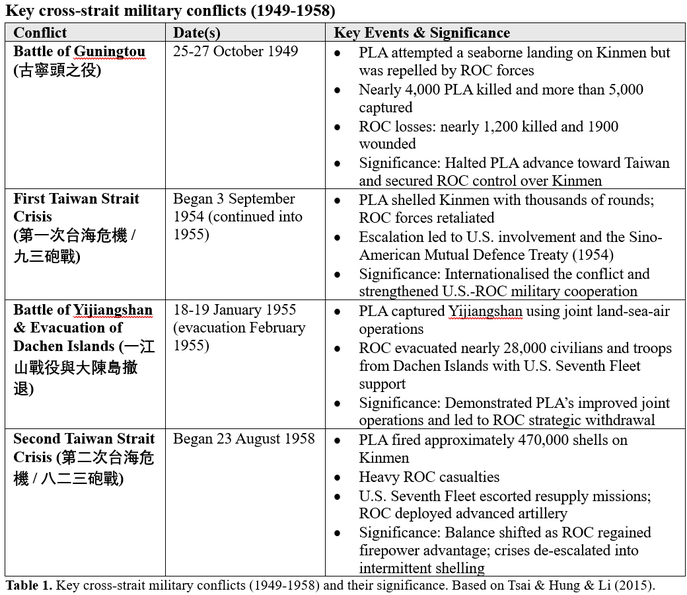
A series of military confrontations between 1949 and 1958 consolidated Kinmen’s place as a forward outpost in cross-strait confrontation. These included the Battle of Guningtou in October 1949, the First Taiwan Strait Crisis in 1954–55, the loss of Yijiangshan and the evacuation of the Dachen Islands in early 1955, and the Second Taiwan Strait Crisis in 1958. The key events and their significance are summarised in Table 1 below. Together, these conflicts established Kinmen as one of the most exposed and symbolically charged frontlines of the Cold War in East Asia (Tsai & Hung & Li 2015).
The emphasis of Kinmen as a lived environment rather than only a strategic site builds on the work of Michael Szonyi. In Cold War Island: Quemoy on the Front Line (2008), Szonyi examines how local civilians experienced war and military rule within the broader context of the global Cold War. Rather than treating Kinmen as a ‘peripheral’ battlefield, he shows how the island was embedded in overlapping local, regional, and global dynamics. His work contributes to a wider shift in Cold War historiography away from a sole focus on superpower rivalry toward the social and cultural dimensions of conflict in ‘peripheral’ regions.
Szonyi also highlights how Kinmen was symbolically constructed within Cold War discourse. For the ROC and its allies, the island was framed as a “beacon of freedom” and as part of a broader strategic frontier within Cold War containment, rather than merely a passive symbol of resistance (Chiu 2023). Its significance extended well beyond the region: during the 1960 U.S. presidential debates, the defence of Quemoy (Kinmen) and Matsu became a point of contention, with John F. Kennedy and Richard Nixon debating whether these offshore islands should be included within the American defensive perimeter. Kennedy maintained that U.S. forces should defend the islands if they were attacked as part of a broader assault on Taiwan, while Nixon rejected drawing any such distinction, arguing that excluding them would effectively abandon them and risk encouraging further communist advances (Kennedy–Nixon Debate 1960). (For those interested, see the debate: https://www.youtube.com/watch?v=ac9dd0dNOqM).
The 1958 bombardment was particularly formative. Halperin’s documented account confirms that on 23 August 1958 the PLA fired tens of thousands of shells on Kinmen in a single day (Halperin 1988). Materials from the Hujingtou Battle Museum likewise emphasise the scale of the attack, noting that more than 30,000 shells struck frontline areas on that day alone (Hujingtou Battle Museum 2025). These figures illustrate the scale of violence, but they also point to a defining feature of life on Kinmen: bombardment was not a singular event but a repeated condition.
What followed the initial phase of the 1958 crisis was not simply recovery but a more regulated pattern of confrontation. Artillery fire continued in an alternating rhythm, in which attacks took place on odd-numbered days, while even-numbered days were used for ceasefire, resupply, and repair (Halperin 1988; Jiugong Tunnels 2025). This pattern continued into the late 1970s. For residents, daily life became structured around a predictable yet precarious rhythm in which danger and periods of relative calm alternated.
The Jiugong Tunnels form part of this history. Carved into granite, they functioned as protected military infrastructure and shelters during periods of bombardment. Constructed in 1963 as part of the so-called “Golden Whale Project,” the tunnels were designed not only for protection but also to support coastal defence and the deployment of small military vessels (Jiugong Tunnels 2025). Today they serve as exhibition sites, but they also remain material traces of a society organised around survival under sustained threat and continue to shape how this history is understood and remembered.

Figure 1. Jiugong Tunnels. Left: emblems of the military construction units associated with the tunnel project, including the 41st Infantry Division (Changshan Unit, lion insignia) and the 34th Infantry Division (Great Wall Unit). Right: artillery drill demonstration staged for tourists, in which uniformed performers simulate the operation of an 8-inch howitzer within the tunnel environment. Photo by the author, April 2025.
This sense of extended and anticipated conflict also appears in visual materials displayed inside the tunnels. One image bears the slogan: “一年準備,二年反攻,三年掃蕩,五年成功” (“prepare for one year, counterattack in two years, sweep out the enemy in three years and succeed within five years”). The phrase presents conflict as a staged process unfolding over several years. Rather than indicating a fixed timetable, such representations reflect a broader political culture in which war was imagined as ongoing and deferred. Lin Guo-hsien’s research shows that the objective of “counterattacking the mainland” shaped policy and propaganda in the 1950s, even as specific timelines became increasingly unrealistic (Lin 2009).
This proximity shaped everyday interactions in more specific ways. Residents and soldiers encountered one another within domestic, communal, and religious spaces, producing both routine contact and moments of tension. Rather than remaining separate spheres, civilian and military life were continually negotiated within shared environments.
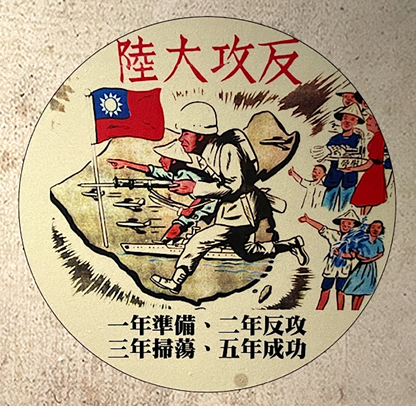
Figure 2. Propaganda poster displayed inside Jiugong Tunnels. The image depicts a Republic of China soldier advancing toward the mainland under the slogan 反攻大陸 (“counterattack the mainland”), accompanied by civilian figures and national symbolism. Photo by the author, April 2025.
Institutional measures were introduced to manage the social effects of prolonged deployment. Military brothels appeared on Kinmen between 1949 and 1953 and were formally regulated in 1954. According to archival records and former officials’ recollections, as discussed in Visions of Marriage: Politics and Family on Kinmen, they were intended to address soldiers’ loneliness and sexual needs, while preventing incidents of violence and maintaining morale (Chiu 2023). These facilities were sometimes referred to as “Soldier’s Paradise” and were later institutionalised under the name Special Military Tea Houses (teyue chashi 特約茶室), functioning as regulated spaces within the military system (Military Brothel Exhibition Hall 2025). They later became colloquially known as “831,” a term used by soldiers and civilians alike. Together, these arrangements illustrate how military authorities sought to regulate not only discipline, but also emotional and social dimensions of prolonged frontline life. This aspect of Kinmen’s history has also been explored in popular culture, most notably in the Taiwanese historical period film Paradise in Service (2014), which is set on Kinmen during the 1960s–1970s and centres on Unit 831, a military-run brothel serving stationed troops.
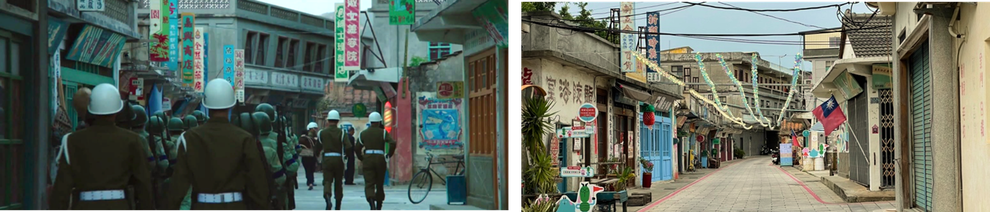
Figure 3. Yangzhai Old Street (Jinsha Township, Kinmen), reconstructed for the filming of Paradise in Service. Left: film still (source: IMDb). Right: the same location photographed by the author (April 2025).
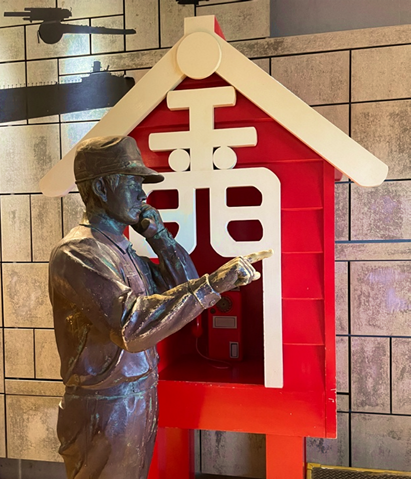
Figure 4. Statue of a soldier using a field telephone at the Hujingtou Battle Museum. The installation incorporates a stylised telephone booth whose structure forms the Chinese characters “金” (jin) and “門” (men), together referencing Kinmen (金門). Visitors can lift the handset to listen to recorded conversations of soldiers, presenting communication archival audio material from the frontline. Photo by the author, April 2025.
Personal accounts provide insight into how this environment was experienced. One testimony describes how soldiers lived in isolation and anticipation, noting that “the cruellest thing was not war itself, or death, but the inexplicable agony of waiting for it” (Military Brothel Exhibition Hall 2025). This observation shifts attention from moments of combat to the prolonged condition of anticipation, suggesting that waiting itself became a defining feature of life on the frontline.
Accounts from the Hujingtou Battle Museum reinforce this perspective. Communication between soldiers and their families – through letters or public telephones – was described as an important source of comfort, offering connection across distance and alleviating isolation. Hearing a familiar voice is described as providing comfort to “lonely and nervous hearts” (Hujingtou Battle Museum 2025).
The physical landscape of Kinmen continues to reflect this history. The Beishan Old Western-style House retains visible bullet marks from wartime fighting. Originally built as a residence in 1928, it was later occupied by different military forces before being restored. The building’s exterior preserves traces of conflict, illustrating how military activity became embedded in civilian structures and everyday environments (Beishan Old Western-Style House 2025).
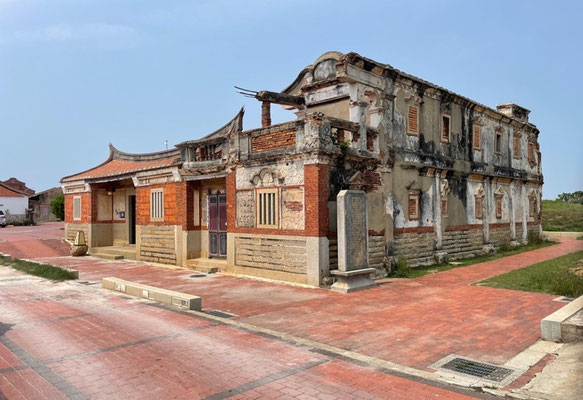
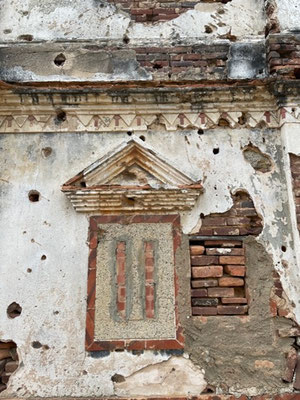
Figure 5. Beishan Old Western-style House (yanglou). Left: Full view of the building, originally constructed as a residence in 1928. Right: Detail of the exterior wall, showing preserved bullet impacts from wartime fighting. The visible damage illustrates how armed conflict became embedded in civilian architecture on Kinmen. Photos by the author, April 2025.
Taken together, these examples show that Cold War Kinmen functioned as a social environment shaped by sustained militarisation over several decades. Conflict influenced governance, space, and everyday routines, integrating military presence into the structures of daily life. For those who lived on Kinmen, war was not only experienced in moments of crisis but also as an ongoing condition.
Following demilitarisation, these lived experiences have not disappeared but have instead been selectively preserved and reframed, contributing to Kinmen’s transformation into what has been described as a “lieu de mémoire” (Denton 2021). Sites such as tunnels, museums, and monuments now present the island’s Cold War past as a narrative of resistance and identity, forming the basis of a tourism economy centred on historical memory.
The next article in this blog series examines one specific dimension of this environment, focusing on cross-strait broadcasting and messaging and how it was experienced within these conditions.
References
Beishan Old Western-Style House (北山古洋樓). 2025. Exhibition materials. Kinmen. Observed by author, April 2025.
Chiu, Hsiao-Chiao. Visions of Marriage: Politics and Family on Kinmen, 1920-2020. New York and Oxford: Berghahn Books, 2023.
Denton, Kirk A. The Landscape of Historical Memory: The Politics of Museums and Memorial Culture in Post-Martial Law Taiwan. Hong Kong: Hong Kong University Press, 2021.
Halperin, Morton H. The 1958 Taiwan Straits Crisis: A Documented History. Santa Monica, CA: RAND Corporation, 1988. https://www.rand.org/content/dam/rand/pubs/research_memoranda/2006/RM4900.pdf (accessed March 18, 2026).
Hujingtou Battle Museum (湖井頭戰史館). 2025. Exhibition materials. Kinmen. Observed by author, April 2025.
Jiugong Tunnels (九宮坑道). 2025. Exhibition materials. Kinmen. Observed by author, April 2025.
John F. Kennedy Presidential Library and Museum. Senator John F. Kennedy and Vice President Richard M. Nixon Fourth Joint Radio-Television Broadcast, October 21, 1960. https://www.jfklibrary.org/archives/other-resources/john-f-kennedy-speeches/4th-nixon-kennedy-debate-19601021 (accessed March 25, 2026).
Lin, Guo-hsien 林果顯. 一九五○年代反攻大陸宣傳體制的形成 [The Formation of the Propaganda System for Reconquering the Mainland in the 1950s]. PhD diss., National Chengchi University, 2009. https://www.ntl.edu.tw/public/ntl/4216/林果顯全文.pdf (accessed March 18, 2026).
Military Brothel Exhibition Hall (特約茶室展示館). 2025. Exhibition materials. Kinmen. Observed by author, April 2025.
Tsai, Tung-chieh, Hung, Ming-te, and Li, Chih-hsien. 圖解兩岸關係 [An Illustrated Guide to Cross-Strait Relations]. 3rd ed. Taipei: 五南出版, 2015.
Troops Headquarters Museum (清金門鎮總兵署). 2025. Exhibition materials. Kinmen. Observed by author, April 2025.